Tensorium Tensorium

Who Are China's Best Machine Learning Server Manufacturers?

Time:2026-11-09 Author:Charlotte
0%

Choosing a machine learning server manufacturer in China means looking beyond brand recognition. Buyers need to match workloads, budgets, and deployment conditions. A training cluster filled with accelerator cards has different demands from a rack serving inference requests. Power draw, cooling, network bandwidth, and component availability all matter.

The market is expanding quickly. IDC’s Worldwide Quarterly Server Tracker reported that global server revenue reached $253.7 billion in 2024, up 91.3% year over year. Much of that growth reflected demand for accelerated servers supporting artificial intelligence. This figure describes the worldwide market, not China’s manufacturer rankings. That distinction matters. It would be misleading to treat global growth as proof that any single supplier leads every Chinese market segment.

Chinese buyers may compare established providers such as Inspur, Lenovo, Sugon, and Huawei, while checking each model’s specifications and support arrangements. The strongest choice depends on evidence: accelerator compatibility, validated performance, delivery timelines, warranty coverage, and service capacity near the deployment site. Ask vendors for workload-relevant benchmarks, not just peak theoretical figures. A useful evaluation also checks rack power limits and whether technicians can replace parts promptly. Small details count.

No ranking fits every project. Vendor names alone are not enough. Product portfolios change, and published performance may not reflect a customer’s software stack. This guide examines what separates leading Chinese suppliers and how buyers can assess their claims with care. Some comparisons remain imperfect; transparent assumptions make them more useful.
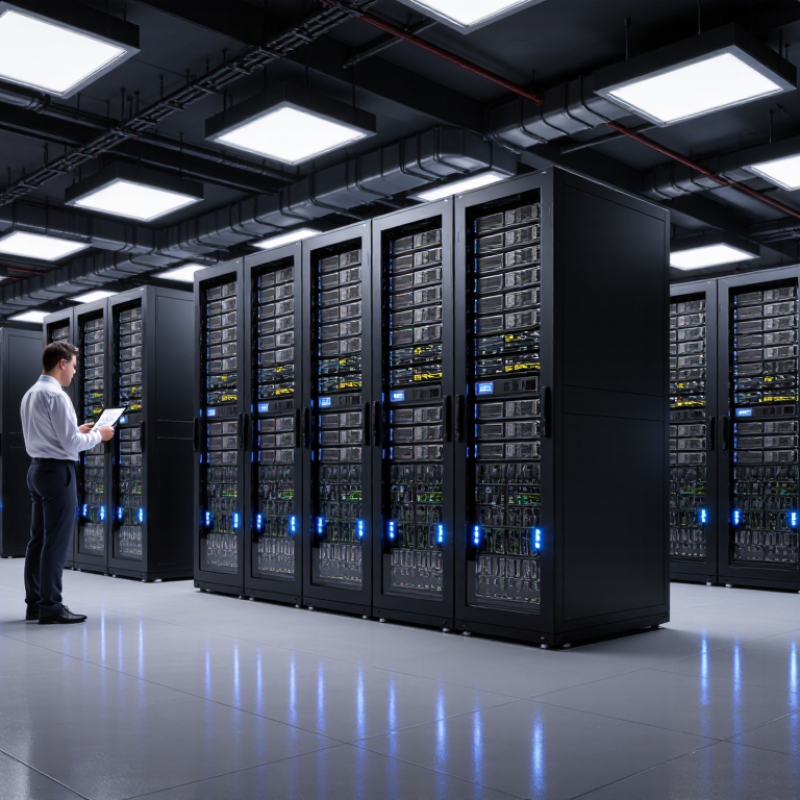
Who Are China's Best Machine Learning Server Manufacturers?

Defining Machine Learning Servers and Their Key Components

A machine learning server is a computer built to train models, process large datasets, or run predictions at scale. Unlike a general office server, it may need several accelerators working together, fast memory, and high-speed links between components. The exact configuration depends on the workload. A small inference task does not need the same hardware as training a large image model.

The processors handle calculations, while graphics processors or other accelerators can speed up parallel operations. System memory keeps active data close to the processors; storage holds datasets and model files. Fast networking matters when multiple servers share a training job. So does cooling. A rack under heavy load can produce substantial heat, and weak airflow may reduce performance or shorten component life. Power supplies must also support sudden demand without instability.

Details matter. A team should check memory capacity, accelerator compatibility, network bandwidth, and the software stack before choosing a system. More hardware is not always better. Some workloads are limited by data access, not computation. That is easy to miss. Benchmarks can help, but results may not reflect everyday workloads. A practical evaluation should use representative data and measure both speed and energy use. Even then, requirements can change as models evolve.

China’s Machine Learning Server Manufacturing Landscape

China’s machine learning server manufacturing landscape is shifting from standard rack assembly toward complete, high-density computing systems. IDC reported that global server revenue reached $253.7 billion in 2024, reflecting surging demand for accelerated computing. That figure is global, not China-specific, but it shows why Chinese manufacturers are investing in power delivery, liquid cooling, and faster production testing.

The market includes established server integrators and specialist manufacturers building systems for model training and inference. Their practical strengths are not identical. Some focus on large-scale rack integration; others compete through configurable platforms, local component sourcing, and support for varied accelerators. TrendForce estimated that global AI server shipments rose about 41.5% in 2024, to roughly 1.67 million units. The estimate signals strong demand, though shipment counts alone cannot measure reliability or useful computing output.

On a factory floor, the difference can be tangible: coolant lines must be checked, power connections inspected, and dense racks tested under sustained loads. Buyers should examine thermal performance, service response, workload benchmarks, and compatibility before comparing headline specifications. Domestic supply chains can improve availability, yet component constraints still matter. One gap is hard to ignore: public, independently comparable reliability data remains limited. That makes careful validation essential.

Who Are China’s Best Machine Learning Server Manufacturers?

China’s Machine Learning Server Manufacturing Landscape

China’s data-center rack capacity provides context for the infrastructure supporting machine-learning servers. Publicly reported figures indicate approximately 6.5 million standard racks in use in 2022 and 7.7 million in 2023. These figures describe infrastructure scale, not server-manufacturer market share or a ranking of manufacturers.

Source: China’s Ministry of Industry and Information Technology (MIIT), publicly reported data; figures are approximate.

Leading Chinese Manufacturers and Their Server Offerings

China’s leading machine-learning server manufacturers typically offer three product types: GPU-dense systems, general-purpose compute servers, and rack-scale platforms. GPU systems combine accelerators with high-speed interconnects, large memory, and NVMe storage. General-purpose nodes support data preparation, inference, and model orchestration. Rack-scale designs integrate power, networking, and cooling for larger deployments.

Cooling choices matter. Air-cooled systems can fit existing data-center racks, while direct liquid cooling can help manage sustained heat from high-power accelerators. Configurations also vary in accelerator count, network bandwidth, and service options. Buyers should verify software compatibility and workload performance using representative tests, not just peak specifications.

IDC reported worldwide server revenue of $77.3 billion in the fourth quarter of 2024, up 91.9% year over year, in its Worldwide Quarterly Server Tracker. This reflects global demand, not a China-only ranking. It does, however, show why accelerator capacity and efficient deployment have become central buying considerations. Manufacturer comparisons can still be imperfect: published benchmarks may use different software, precision settings, and power limits. Ask for comparable test results and inspect the actual rack, cabling, and cooling plan before selecting a system.

How to Compare Machine Learning Server Manufacturers

Comparing machine learning server manufacturers starts with the workload, not the brochure. A vision model trained on image batches may need several accelerators and fast local storage. A retrieval system may depend more on memory capacity and network bandwidth. Record model size, data volume, expected users, and likely growth over two years. Details matter.

Ask each manufacturer for a tested configuration and the conditions behind its performance figures. Compare results using the same model, dataset, software version, and precision settings. Request details on power use, cooling, and sustained performance under long training runs. Numbers need context. A short benchmark may miss thermal throttling or slow data loading. Ask how the server connects to existing storage and network equipment, too.

Check support arrangements as carefully as hardware specifications. Confirm response times, spare-part availability, firmware update procedures, and who diagnoses problems remotely. Ask whether staff can help tune workloads after installation, not only deliver the system. Fit matters. A polished quote can still omit the details that cause delays in a real data center. I would not treat an early comparison as final; requirements often change once teams run actual workloads.

Who Are China's Best Machine Learning Server Manufacturers? - How to Compare Machine Learning Server Manufacturers
Comparison Dimension What to Check How to Compare Fairly Why It Matters
Accelerator Configuration Supported GPU or other accelerator models, number of accelerators per system, memory capacity, and interconnect options. Compare systems configured for the same accelerator type and count. Verify compatibility in the system specification and accelerator vendor documentation. Training and inference performance depend heavily on the accelerator, its memory, and how efficiently devices communicate.
CPU and Host Memory Processor model and core count, memory capacity, memory type, supported speed, and error-correcting code (ECC) support. Check the bill of materials and validated configuration. Compare memory capacity and CPU resources alongside the intended workload, not in isolation. Data loading, preprocessing, and host-to-accelerator work can become bottlenecks when CPU or system memory is insufficient.
Storage and Data Throughput Drive types, usable capacity, RAID options, drive-bay count, and supported storage interfaces. Compare measured read and write performance using the same drive setup and workload. Distinguish advertised drive speed from end-to-end system throughput. Fast, appropriately sized storage helps keep training data available to accelerators and supports checkpoints and model datasets.
Networking Available Ethernet or high-speed fabric options, port count, link speed, and support for the required adapters. Confirm that network adapters, switches, cables, and software are compatible. Compare results using the same network topology and test conditions. Distributed training and shared-storage access can be limited by network bandwidth, latency, or configuration.
Power and Cooling Power-supply capacity and redundancy, cooling design, supported operating environment, and rack power requirements. Request power and thermal requirements for the exact configuration. Check facility capacity and cooling limits before comparing system size or density. Accelerator-heavy systems can require substantial power and cooling; inadequate infrastructure may prevent reliable operation.
Expansion and Serviceability Available expansion slots, drive bays, memory capacity, service access, and component replacement procedures. Review chassis and configuration documentation. Confirm which components can be upgraded and whether upgrades affect warranty coverage. Expansion options affect the system's useful life, while accessible components can reduce maintenance effort and downtime.
Software and Compatibility Operating-system support, accelerator drivers, firmware, container support, and compatibility with common machine-learning frameworks. Ask for a supported software and firmware matrix for the proposed configuration. Validate the required versions in a proof of concept. Hardware performance is useful only when the software stack is stable and compatible with the intended workloads.
Reliability and Support Warranty terms, service response options, spare-parts availability, firmware update process, and escalation procedures. Compare written service-level terms and coverage for the deployment location. Ask how replacement parts and technical support are handled. Support quality affects recovery time and operational risk, especially for production systems and large deployments.
Performance per Cost System price, power use, support costs, and measured performance on the target workload. Use the same benchmark, dataset, software versions, and configuration. Compare total cost of ownership rather than purchase price alone. Workload-specific testing gives a more useful comparison than peak specifications that may not reflect real tasks.

Industries and Workloads Served by Chinese Manufacturers

Chinese machine-learning server manufacturers support workloads across manufacturing, finance, telecom, healthcare, and scientific research. Factory teams use GPU-equipped systems to inspect surface defects from camera feeds and predict equipment failures from sensor data. Banks run risk models and fraud detection, while telecom operators process network traffic and serve AI applications. Hospitals and research centers need servers for medical-image analysis, simulation, and model training. Latency matters. A server suited to overnight model training may not fit a clinic’s real-time image workflow.

Demand is expanding, but workload growth brings practical constraints. IDC’s 2024 Worldwide AI and Generative AI Spending Guide projects global generative-AI spending of $143.3 billion in 2027, with a 73.3% compound annual growth rate. This is a global forecast, not a China-only estimate. The IEA’s Electricity 2024 report says data centers used about 460 TWh of electricity worldwide in 2022, and consumption could exceed 1,000 TWh by 2026. That scale makes power draw, cooling, and rack density important purchasing factors for Chinese manufacturers and their customers. Not every job fits. Buyers should test representative data, software, and peak loads before selecting a configuration; benchmark results alone can hide integration and operating costs.

FAQS

What is a machine learning server?

It is a computer built to train models, process large datasets, or run predictions at scale. It may use several accelerators, fast memory, and high-speed networking.

Which components matter most for machine learning workloads?

Check processors, accelerators, memory, storage, network bandwidth, cooling, and power supplies. The right balance depends on the workload. More hardware is not always better.

Do all machine learning tasks need multiple accelerators?

No. A small prediction task may need less hardware than training a large image model. Some systems are limited by data access, not computing power.

How should buyers compare server performance?

Test the same model, dataset, software version, and precision settings on each system. Ask for sustained performance and power-use results. Numbers need context.

Why should teams inspect cooling plans?

Heavy workloads produce substantial heat. Weak airflow can reduce performance or shorten component life. Liquid cooling may help with sustained heat, while air cooling can fit existing racks.

What should buyers check beyond peak specifications?

Verify software compatibility, network and storage connections, and performance with representative data. A short benchmark can miss thermal throttling or slow data loading.

What support details should a buyer confirm?

Ask about response times, spare parts, firmware updates, and remote diagnosis. Check whether staff can help tune workloads after installation. Delivery alone may not be enough.

What does recent server market growth tell buyers?

Worldwide server revenue reached $77.3 billion in the fourth quarter of 2024, according to IDC. That figure is global, not a China-only ranking. I would not treat it as a direct guide to one purchase.

How can teams prepare for changing requirements?

Record model size, data volume, expected users, and likely growth over two years. Then test with actual workloads. Plans change.

Conclusion

Machine learning servers are purpose-built systems designed to handle demanding workloads such as model training, inference, and large-scale data processing. Their performance depends on components working together, including accelerators, processors, memory, storage, networking, cooling, and power management. China’s manufacturing landscape includes companies with different areas of expertise, from complete server platforms to specialized configurations for particular computing needs.

Choosing a machine learning server manufacturer involves comparing processing capacity, expandability, energy efficiency, reliability, technical support, and compatibility with existing software and infrastructure. The right system also depends on the intended workload: research organizations may prioritize flexible training capacity, while businesses running real-time applications may focus on dependable inference and efficient deployment. Evaluating these factors helps organizations identify a suitable manufacturer and server configuration for their operational requirements.

Charlotte

Charlotte

Charlotte is a seasoned marketing professional with a deep understanding of the company's portfolio and a passion for elevating its presence in the market. With a keen eye for detail and a commitment to excellence, she ensures that our professional blog is regularly updated with insightful articles......