Tensorium Tensorium

Who Is the Best Deep Learning Server Manufacturer in China?

Time:2026-11-02 Author:Charlotte
0%

Choosing the best deep learning server manufacturer in China is not a simple brand contest. It is a decision about workload, reliability, service, and long-term cost. Andrew Ng, a leading AI researcher and educator, captured AI’s wider importance with the phrase, “AI is the new electricity.” That idea has a practical hardware side: models need dependable computing systems, not just ambitious plans.

A useful comparison should look beyond processor names and glossy product photos. It should examine GPU options, memory capacity, storage speed, cooling design, and power use. These details matter in real deployments. A server running overnight training jobs faces different demands from one serving predictions throughout the day. Buyers should also ask about compatibility, spare parts, warranty terms, and response times when equipment fails. Small details count. A delayed replacement fan can disrupt a carefully scheduled workload.

China’s deep learning server manufacturer landscape includes suppliers with different strengths, product ranges, and support capabilities. The right choice depends on the buyer’s team, budget, data center, and intended models. Published specifications help, but they do not prove performance under every workload. Requesting a configuration review or a workload-specific test can reveal important gaps. Even then, results need careful interpretation. One benchmark cannot represent every production environment. This comparison will outline practical criteria for evaluating manufacturers and explain which questions deserve attention before purchase. There may be no universal winner. That is less satisfying, perhaps, but more useful.
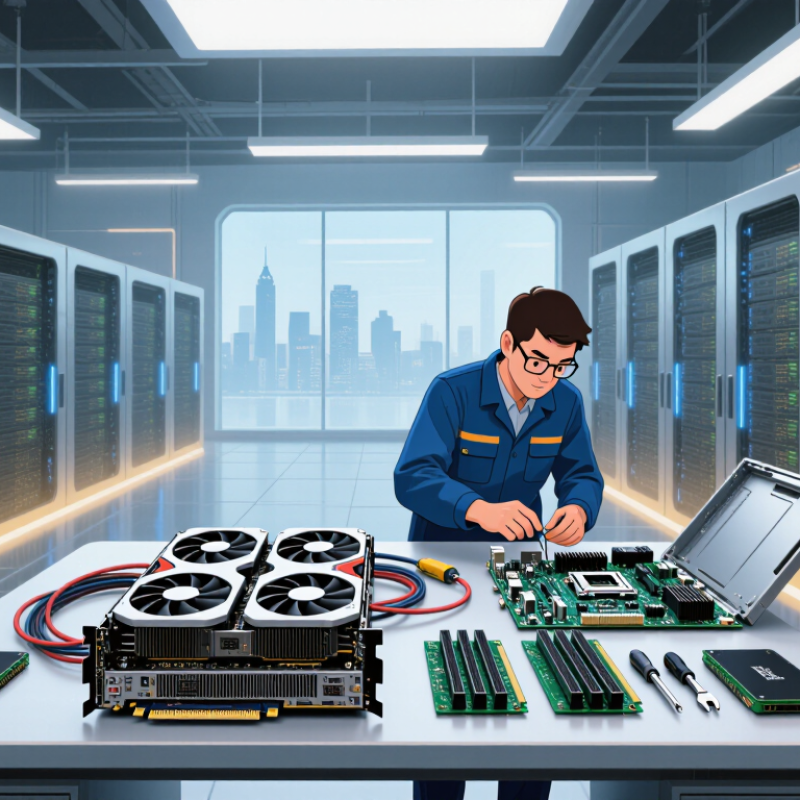
Who Is the Best Deep Learning Server Manufacturer in China?

What Defines China’s Best Deep Learning Server Manufacturer?

A strong deep learning server manufacturer is defined by more than processor counts or impressive peak performance. The system should sustain real workloads without throttling when several accelerators run for hours. Ask for benchmark results that state model size, precision, batch size, and software versions. Clear test conditions make comparisons more useful. So does honest disclosure of power draw and cooling limits.

Look closely at the engineering details. Can the chassis move hot air away from dense accelerator cards? Are power supplies, memory, and high-speed network adapters sized for the intended workload? A useful manufacturer also provides practical configuration guidance, firmware updates, and responsive technical support. These details matter when a training run stalls at midnight. No scorecard captures every workload, and I would not pretend otherwise. A polished specification sheet can still leave unanswered questions.

Tips: Request a workload-based demonstration, not just a peak-performance number. Check service response times and spare-part availability. Ask how the server behaves during sustained operation, then verify the results with your own models. Small details count.

How Inspur, Lenovo, Huawei, H3C, and Sugon Compare in 4-GPU and 8-GPU Systems

A fair comparison of deep learning server manufacturers in China starts with the workload, not the product label. Four-GPU systems can suit model development, fine-tuning, and smaller inference jobs. They usually need less rack space and may be easier to cool. Eight-GPU systems can support larger training runs, but only when GPU-to-GPU links, memory capacity, and power delivery match the workload. An eight-GPU label alone proves little. Check measured performance with your own models; published benchmarks may use different software settings.

Tips: Ask for a live workload demo. Check wall-power draw, fan noise, and GPU temperatures during sustained operation.

Compare complete configurations, not just GPU counts. Review accelerator model, interconnect, CPU and memory balance, storage speed, and support response times. Confirm that the system can run your preferred frameworks and that replacement parts are available locally. A technically strong machine can still disappoint if installation or maintenance is slow. I would also treat attractive benchmark claims cautiously; cooling, precision settings, and batch size can change results. That comparison takes time, and I have seen teams overlook the rack’s power limits. Check those before ordering.

Who Is the Best Deep Learning Server Manufacturer in China? — Comparing 4-GPU and 8-GPU Systems

This is a configuration-level comparison, not a vendor ranking. Actual specifications vary by server model, accelerator, and configuration.

Evaluation Dimension 4-GPU System 8-GPU System
Accelerator Count Four accelerators; suitable for many development, inference, and medium-scale training workloads. Eight accelerators; provides more parallel compute capacity for larger training and inference workloads.
Accelerator Power As a planning estimate, many current data-center accelerators draw roughly 300–700 W each, or about 1.2–2.8 kW for four accelerators alone. Using the same broad planning range, eight accelerators draw about 2.4–5.6 kW in total. Actual power depends on the installed accelerator models.
Chassis and Expansion Four-GPU platforms are available in several chassis sizes. Confirm card dimensions, slot spacing, and room for network and storage adapters. Eight-GPU platforms generally need more internal space and careful component layout. Chassis size depends on accelerator form factor and cooling design.
GPU-to-GPU Communication May use PCIe connections or an accelerator-specific high-speed interconnect. Confirm the topology supports the intended workload. Interconnect topology becomes especially important as accelerator count rises; verify which accelerators can communicate directly and at what bandwidth.
Cooling Requirements Requires server-grade airflow matched to the accelerator thermal design. Check operating limits and airflow direction before deployment. Higher total heat output makes rack airflow, inlet temperature, and cooling capacity more demanding. Some configurations may require specialized cooling.
Power Delivery Check the server’s power-supply capacity, redundancy configuration, and the facility’s available circuits. Requires greater power-delivery capacity. Validate rack power, circuit limits, and redundancy under the fully populated configuration.
Host CPU and Memory Match CPU, system memory, and PCIe resources to the accelerator workload; avoid bottlenecks in data loading and preprocessing. More accelerators can increase CPU, memory, and I/O demands. Confirm balanced host resources and sufficient connectivity for all devices.
Deployment Fit Often a practical choice when rack power, budget, or workload scale favors a smaller accelerator count. Often better suited to workloads that can use additional parallel compute and have the power, cooling, and network infrastructure to support it.
Key Procurement Checks Request the exact supported accelerator list, measured power figures, thermal limits, and validated software configuration. Request the same details, plus full-system power and cooling requirements, interconnect topology, and performance results for the target workload.

The power figures above are broad planning estimates for accelerator cards only, not complete-system consumption. Compare exact system configurations and workload benchmarks before selecting a server.

How MLPerf Training and Inference Results Verify Vendor Performance

Choosing a deep learning server manufacturer in China requires more than comparing processor counts. MLPerf Training measures the time needed to reach a defined quality target across workloads. MLPerf Inference reports performance under scenarios such as single-stream, offline, and server use. These results make comparisons more meaningful, provided the tested configurations and software versions are examined.

MLCommons’ MLPerf Training v4.0 results cover language, vision, and recommendation workloads. Its Inference v4.1 results help show whether a system can sustain throughput while meeting latency limits. Look closely at the test conditions: a fast result under one workload does not guarantee strong performance on another. Cooling, memory capacity, and accelerator communication can change results in a real data center.

The Stanford Institute for Human-Centered AI’s AI Index 2024 reports that training compute for notable AI models has doubled roughly every five months. That pace makes repeatable testing important. Still, benchmark tables leave gaps. They do not fully capture maintenance needs, power costs at a customer’s site, or performance after months of use. I would treat them as evidence, not a verdict. A buyer should ask for comparable test settings and verify results with a representative workload.

How GPU Memory, NVLink Bandwidth, and 400GbE Affect Model Scaling

A deep learning server can have powerful GPUs and still struggle when a model outgrows available memory. GPU memory determines how much of a model, its activations, and its working data can stay close to the processors. When capacity is tight, teams may need smaller batches or distributed training. Both choices can slow experiments. More memory helps, but it is not a complete solution.

NVLink bandwidth matters when GPUs exchange parameters or intermediate results frequently. A fast interconnect can reduce communication delays, especially in tightly coupled workloads. Yet results depend on topology, software, and how the model is partitioned. More links do not automatically mean faster training. Measure real workloads, not just peak specifications. Small details matter.

For multi-node training, 400GbE can provide substantial network capacity, but only when switches, adapters, cabling, and storage paths keep pace. Poor network configuration can leave expensive GPUs waiting. Ask manufacturers for test results using comparable model sizes and node counts, and check how they monitor congestion and cooling. These checks are useful, though benchmarks rarely capture every production workload. I would not choose a system from one headline number; even careful estimates can miss an awkward bottleneck.

How 10-kW-Class Server Power, Cooling, and TCO Shape the Best Choice

Choosing a deep learning server manufacturer in China starts with the rack, not the brochure. A 10-kW-class server can concentrate substantial heat in a small space. Check whether the proposed cooling method matches your room’s airflow, water connections, and operating limits. Ask for measured power and thermal data under representative workloads, not just peak specifications. A temperature probe near the rack’s rear door can reveal airflow problems that a room-level reading misses. Small details matter.

Cooling affects total cost of ownership through electricity, equipment, maintenance, and usable compute capacity. Compare the complete system: servers, distribution hardware, cooling, installation, and service over several years. Request clear assumptions for energy use and workload utilization. Then validate them with a pilot rack, since lab results may not reflect your site. No spreadsheet captures every operational surprise. I would also examine service response times, spare-parts availability, and how quickly technicians can diagnose a failed fan or pump. A lower purchase price may look attractive, but recurring cooling costs can change the calculation. Conversely, complex liquid cooling is not automatically the right choice; it needs compatible facilities and trained support.

10-kW-Class Deep Learning Server: Power, Cooling & TCO

Illustrative calculations, not manufacturer measurements: with a constant 10 kW IT load, total facility power is IT load × PUE. Facility overhead (including cooling and other infrastructure) is therefore 2, 4, or 6 kW at PUE 1.2, 1.4, or 1.6. At continuous full load for 8,760 hours per year and an assumed electricity price of $0.10/kWh, estimated annual electricity costs are $10,512, $12,264, and $14,016, respectively. Actual TCO depends on workload, utilization, local tariffs, and measured site efficiency.

FAQS

When is a four-GPU system a practical choice?

It can suit model development, fine-tuning, and smaller inference jobs. It usually needs less rack space and may be easier to cool. Measure your workload.

Does an eight-GPU system always train models faster?

No. GPU links, memory, and power delivery must match the workload. More GPUs alone prove little.

What should I compare beyond GPU count?

Check the accelerator, interconnect, CPU, memory, storage, and support response times. Confirm that your software frameworks run properly. Small configuration details matter.

How can benchmark results help compare systems?

Training tests can measure time to a target quality, while inference tests assess throughput and latency. Compare test settings and software versions. Not a verdict.

Why test a server with my own workload?

Different models, batch sizes, and precision settings can change performance. Request a live demonstration with representative data. I might trust a chart too quickly.

What should I check before installing a high-power server?

Measure rack power limits and review airflow, cooling connections, and operating conditions. Ask for power and temperature readings under sustained workloads. Check the rear aisle.

How can cooling affect total cost?

Include electricity, cooling equipment, installation, maintenance, and service in your estimate. Test assumptions with a pilot rack. Spreadsheets miss surprises.

What operational details can affect long-term performance?

Check local replacement-part availability and technician response times. Ask how staff diagnose a failed fan or pump. Downtime counts, too.

Conclusion

Choosing the best deep learning server manufacturer in China requires looking beyond headline specifications. A meaningful comparison should assess how 4-GPU and 8-GPU systems perform under real training and inference workloads, using independent benchmark results where available. It should also consider whether GPU memory capacity and high-speed interconnects can keep data moving efficiently as models and workloads grow. Network bandwidth, including 400GbE options, may further affect distributed scaling.

Operational requirements matter just as much as compute performance. Servers approaching 10 kW demand careful attention to power delivery, cooling design, rack capacity, and energy use. Buyers should compare these factors alongside reliability, support, and total cost of ownership over the system’s expected service life. The strongest choice is the one that balances verified performance, scalable architecture, and practical deployment needs.

Charlotte

Charlotte

Charlotte is a seasoned marketing professional with a deep understanding of the company's portfolio and a passion for elevating its presence in the market. With a keen eye for detail and a commitment to excellence, she ensures that our professional blog is regularly updated with insightful articles......